
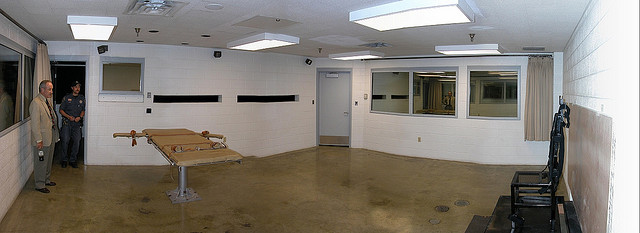
I seldom discuss the death penalty. Throughout my life there have been times when I supported it, and others when I believed it served not purpose. It was meant to be a deterrent, but the facts prove that it is not successful in that intention. I agree that putting an individual to death is likely inhumane and even immoral, but that the people of each state must decide if they would be able to vote in favor of ending a person’s life.
A decision made by the Supreme Court this week has placed 390 inmates on death row in a state of limbo in Florida. Florida’s law unconstitutionally gave judges the power to decide circumstances which would make the death penalty applicable; the juries should have been allowed to decide if capital punishment was a reasonable alternative.
In an 8-1 decision, the Court created questions about not only those now on death row, but also two inmates scheduled for execution in February and March. It has yet to decide if the decision will be retroactive.
My reason for writing this occurred to me as I was reading the article. I asked myself; “could I make a decision to end another human being’s life?” I considered the worst case scenarios, such as a serial killer, the abuse and death of a minor at the hands of an adult, and acts of cowardice by self-proclaimed terrorist murdering innocent people.
I am not a religious man, but I believe in many of the principles the Bible and also in the Quran. One stood out above the others when Jesus Christ told his followers: “Judge not lest ye be judged.” I also believe in forgiveness; hatred results in the death of the soul. But I also believe in victim’s rights. Is life imprisonment without the possibility of parole sufficient punishment for such heinous crimes?
In the back of my mind, I continue to vacillate. But I came to a logical conclusion.
I know that I could not decide to end the life of another under any circumstances. I don’t believe that I have the right or the power to make such a decision; if there is a God, that’s for Him or Her to decide. Secondly, if the victim’s families are seeking vengeance, they are existing in a world filled with hatred, and will never heal and find closure, even after the death of their tormentor. I also believe that the knowledge that the offender will be confined in a prison for the remainder of their earthly existence, and never experience any form of freedom, would possibly be a more severe punishment; they would have no ‘life.’
Lastly, I know that I have read too many novels and watch too much television, but if there was a one-in-a-million chance that the person was wrongly convicted, and I voted to end his or her life, my conscience would place me in a virtual prison for the remainder of my life.
For me, abolishing the archaic act of punishing an individual for the loss of life by ending their own is logical. Many inmates live one or two decades on death row while the appeal process is concluded, and this is very costly for taxpayers.
Op-Ed
By James Turnage
Photo Courtesy of Tommy Woodard
Read ‘James Turnage’ on the free Amazon Kindle App
 The Truth With No Restrictions