
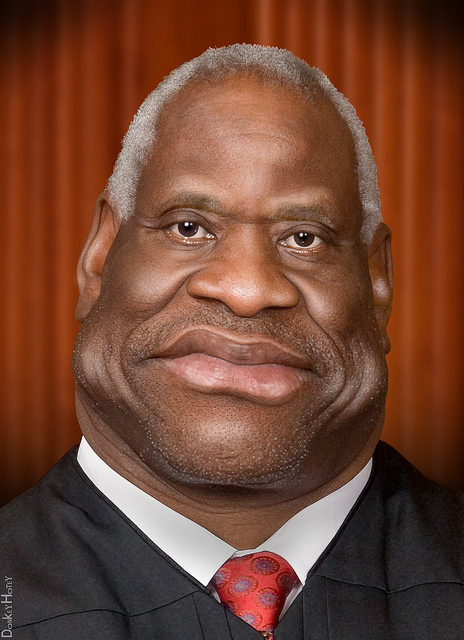
A recent decision by the Supreme Court brings forth a question. Was Clarence Thomas’ vote the result of what he believed Antonin Scalia would have done, or did he really believe in his dissent?
The case received a 7-1 decision, with Thomas being the lone dissenter. He added to the controversy regarding his appointment, but this time for reasonable doubt about his understanding of the Constitution.
I know most Americans fail to understand that the only purpose for the Court is to decide if cases before it violate the Constitution. Justices are not allowed to make decisions based on personal beliefs. In this case, the petitioners were claiming that an individual’s civil rights had been violated; it had nothing to do with the man’s guilt or innocence pertaining to the crime.
So what was before the Supreme Court which impressed seven out of eight justices, but gave Thomas no concern? It is a case in the red state of Georgia, which occurred nearly 30 years ago. Timothy Foster was an 18-year-old black man. He was convicted of murdering Queen White, a 79-year-old retired teacher by beating and strangling to woman. In addition, he molested her with a salad dressing bottle. An all-white jury convicted Foster of capital murder and sentenced him to death.
Nineteen years after the conviction, notes from prosecutors were discovered, and indicated the guarantee that no black jurors would be selected. In 1999 Foster requested a new trial based on ‘intellectual disability.’ Under the Georgia Open Records Act, all of the prosecution’s notes and memos became available to Foster’s lawyers. Their appeals eventually reached the Supreme Court of the United States.
Chief Justice John Roberts wrote the majority opinion, saying: “The focus on race in the prosecution’s file plainly demonstrates a concerted effort to keep black prospective jurors off the jury.” Foster will likely receive a new trial. He is 48-years old.
Thomas did not agree and entered this statement in his dissent: “Foster’s new evidence does not justify this court’s reassessment of who was telling the truth nearly three decades removed from voir dire,” Thomas wrote in a dissenting opinion.
This is the error in Thomas’ misguided opinion. In a capital murder case even the smallest injustice is of great consequence. Not only could it involve the guilt or innocence of the accused, but also the penalty.
Having watched Thomas’ confirmation hearings in 1999, I was appalled that he was allowed to receive a seat on our nation’s highest court. He immediately became Scalia’s protégée, and never met a conservative ideal he didn’t like.
Today, he continues to offer proof that his confirmation was an egregious mistake.
Meanwhile, the Court continues to have a vacancy; a vacancy which will remain for more than a year thanks to the obstructionism of Mitch McConnell.
The difference between Merrick Garland and Thomas is extensive. Thomas was certainly a womanizer and lacked the necessary qualifications to sit on the Court. Garland is a highly respected judge who is now the Chief Justice of the Appellate Court. He has been praised by both parties, but, thanks to the Senate Majority Leader, a seat remains vacant and forces the Court to be dysfunctional in far too many instances.
Op-Ed
By James Turnage
Photo Courtesy of DonkeyHotey
 The Truth With No Restrictions