
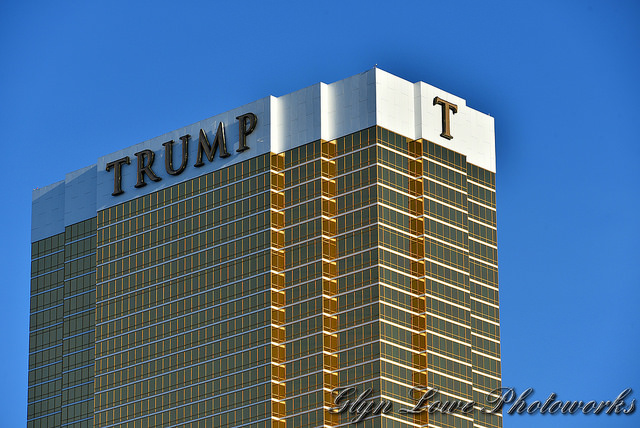
Donald Trump has refused to produce his tax returns. It is not a requirement for a presidential candidate to reveal them to the public, but it has become a tradition. If a candidate refuses to produce them, he or she justifiably receives enormous scrutiny. This is what Trump is facing today.
Questions began immediately. What is he hiding? Recent events question his ties with Vladimir Putin. He claims to be extremely wealthy; is that the truth?
The New York Times performed its own investigation. It appears that Mr. Trump has greatly exaggerated his business success. He is another American in debt.
With no experience at any level of government, Trump’s only self-proclaimed accomplishment is his business success, and his claim that he is a self-made man who owes no one else for the billions of dollars he has amassed. It is now evident that Trump has once again ‘stretched the truth’ a bit.
The New York Times has discovered that Trump’s businesses are more than $650 million in debt. Without multiple financial backers, he would be your local real estate agent.
Trump’s investments are extremely complicated, involving complex ownership, and mortgage structures. One example given by the Times is an office building located on the ‘Avenue of the Americas’ in Manhattan. Trump is a part owner of the building. The structure carries a $950 million loan. Among the investors are two organizations heavily criticized by Mr. Trump; The Bank of China, and Goldman Sachs.
Trump has been a consistent critic of China, and has ostracized Hillary Clinton for earning $675,000 in speaking fees for a speech made for Goldman Sachs’ employees.
Early in his campaign, Trump was required to disclose his financial situation. He claimed that his companies owed $315 million to a small number of institutions. He also claimed that he had ties to more than 500 limited liability companies. During their investigation, the Times discovered that most of his wealth is contained in three ‘passive’ partnerships, and they are in debt for an additional two-billion-dollars to multiple lenders, including those involved in the building located on the Avenue of the Americas.
“I am the king of debt,” Mr. Trump once said on CNN. “I love debt.” But in his career, debt has sometimes gotten the better of him, leading to at least four business bankruptcies.
How can voters believe anything Mr. Trump says? If his only ‘claim to fame’ is business success, and that success is actually a façade, can we have any faith in his rhetoric regarding future actions as our nation’s president?
Trump continues to face legal action for his questionable business practices. In November, after the election has been held, allegations directed at “Trump University” will be heard in a court of law. The plaintiffs are students who enrolled in the “university” who are claiming fraud. Classes consisted of a series of lectures at various locations, given by instructors who allegedly lacked qualified credentials.
Trump has been called many things; and most are fair. Possibly the word which describes him most accurately is “phony.” It appears that everything in Trump’s life is based on fantasy rather than reality.
His new campaign manager has forced Trump to use a teleprompter, thus toning down his outlandish rhetoric, and making him appear more serious and ‘presidential.’ It is somewhat successful, with the exception of his continuation of avoiding specifics.
We have watched Trump for more than a year; we know who he is, what he is, and what he is not. What he is not is a qualified presidential candidate. Trump has the misfortune of challenging the most qualified candidate in the history of our nation.
The only thing about Trump which is “huge” is his imagination.
Op-Ed
By James Turnage
Follow me on Twitter: @jamesturnagenov
 The Truth With No Restrictions